
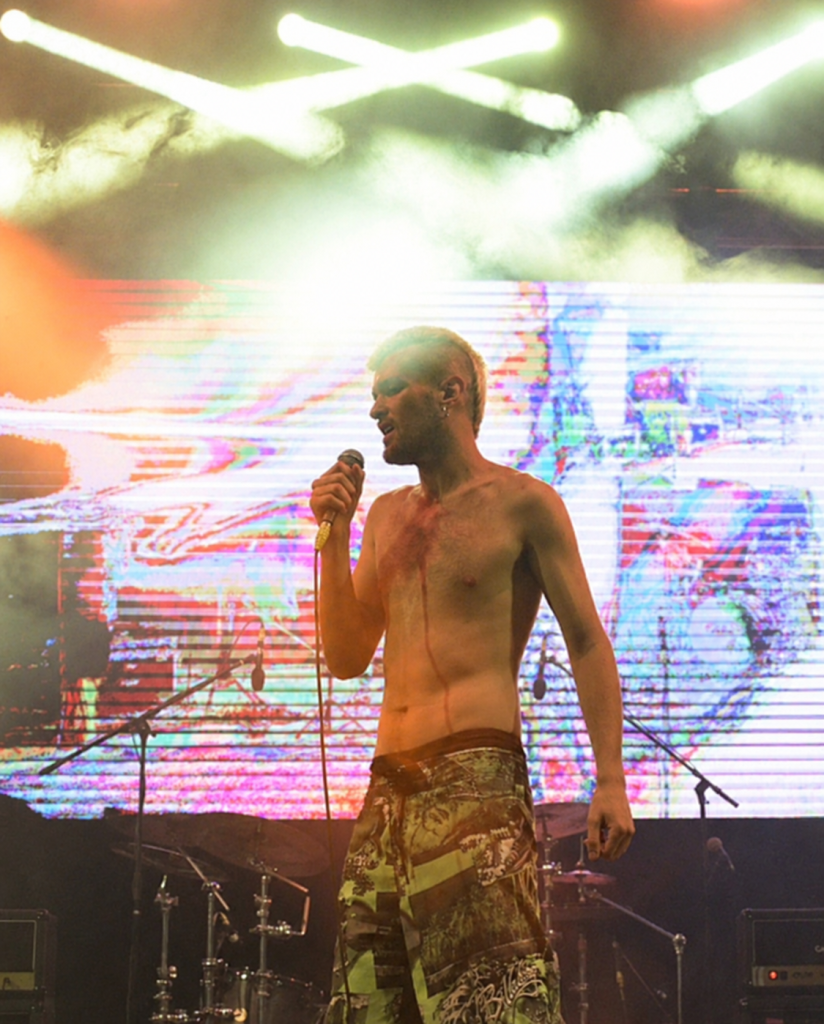
Beyond the sound. Beyond the image. The human behind the noise.
For this edition of THE HUMAN BEHIND THE NOISE, we step into the world of BLCK.RS, an artist whose creative expression extends far beyond music.
From sound and live performance to fashion, visual art and community projects, his work explores the connections between creativity, emotion and human experience.
We talked about the experiences that shape his art, the meaning of underground culture, the importance of creating spaces for others, and the humanity that exists beneath even the most aggressive sounds.
Who is the person behind your many forms of artistic expression?
I’m an individual that has never really been able to separate doing from trying to understand myself.
BLCK.RS is the name attached to the music, the performances, the visuals and everything surrounding them, but behind that there is simply a human being trying to process life through creation. I come from rap vocals and experimental rock, but eventually I found myself moving through electronic music, techno, trip-hop, metal, cloud rap, experimental sounds and everything in between. I don’t really see those as separate identities. They are different languages I use depending on what I need to express.
I am also interested in the human and spiritual dimensions of improvisation, the thought processes that precede creation, and the broader processes of making music beyond the act of writing itself.
Everything is an extension of the same instinct: to create something that feels real enough for someone else to recognize themselves in it.
At the centre of it, I’m evolving as a person, and my person evolves through me.
What first made art such an essential part of your life?
Art became essential to me because life gave me experiences I didn’t know how to process in any other way.
Certain deeply traumatic events changed my understanding of connection, absence, and what it means for someone to suddenly no longer be there. Later experiences of abandonment and the difficulty of finding a sense of safety continued to shape my relationship with the world and the way I perceive it.
I don’t necessarily think about these experiences every time I create something, but they have influenced the way I observe everything, as well as my professional path and my broader vision of the world. They have made me more sensitive to emotions, atmospheres, people, and the things that remain unspoken.
Over time, art became a space where I could give these experiences a form without having to explain them. A track can hold a feeling without naming it. A piece of clothing can communicate an idea without requiring a verbal explanation. Through my clothing brand, I have also come to understand that there are many different forms of expression, each with its own language and way of communicating something that words alone cannot always convey.
That is probably why art became essential to me. It was never initially about becoming an artist, but about finding a place for everything I couldn’t otherwise express through words or body language.
BLCK.RS – THANATOS
Alongside this conversation, BLCK.RS joins EXIT7 RECORDS with THANATOS, a work that reflects the darker side of his artistic expression.
Listen to THANATOS on SoundCloud:
Music, bands, fashion and community projects. Different worlds or one creative vision?
I see it as one creative vision taking shape through different worlds.
Music is perhaps my primary language, but the ideas behind it naturally find their way into fashion, visual art, events, spaces and collaborations. Each medium offers a different way of exploring the same questions, emotions and contradictions. I’m interested in how an idea can transform as it moves from sound to image, from an object to an experience, or from an individual expression into something shared by a community.
DEADZION is an example of this. More than a clothing label, it is an extension of a world I’m building around the idea of “Dead Paradise”: the tension between destruction and possibility, between what has been lost and what can still emerge from it. Music, clothing and visual language become different ways of inhabiting and expressing that same universe.
Community projects extend this vision beyond the work itself. If I explore connection, loneliness, transformation or identity through art, I’m equally interested in creating spaces where these ideas can become lived experiences, where people can encounter one another and find meaning in something shared.
I don’t see these practices as separate worlds, nor do I think they need to become identical. Each has its own language and its own possibilities, but they are connected by a common sensibility. Ultimately, I’m interested in creating a world that can be experienced in different ways, through sound, image, clothing, space and human connection. Different forms, different entrances, but the same underlying vision.
You say, „I make art to make you angry or sad.“ Why are these emotions so important to your work?
Because I don’t think art always has to make you comfortable.
Anger can mean that something still matters to you. Sadness can mean that something mattered enough to be lost. Both emotions can force you to stop for a moment and actually feel what is happening.
I’m also interested in what art can bring to the surface of the unconscious. Sometimes, we carry experiences, emotions or parts of ourselves that have been buried, suppressed or frozen for so long that we lose touch with them. I believe art has the potential to awaken these dormant parts of us, to bring something hidden into our awareness, even if we don’t immediately have the words to understand it. For me, this is an essential part of healing: not necessarily finding answers, but allowing ourselves to feel and recognise what has remained unprocessed.
A lot of contemporary culture is designed to make everything immediately digestible. I’m interested in the opposite sometimes. I want a sound, image or garment to stay with you for a while. Maybe it makes you uncomfortable. Maybe it brings you face to face with something you’ve been avoiding. Maybe it awakens a feeling you didn’t even realise was there.
That doesn’t mean I want people to suffer through the work. Quite the opposite. I think difficult emotions can become a form of connection, and that confronting something painful can open up the possibility of understanding it differently.
If someone encounters something I’ve created and recognises a feeling they have carried silently for years, or becomes aware of something within themselves they had forgotten or learned to suppress, then the work has already done something meaningful. If it allows them to feel less alone in that experience, perhaps it has also created a small opening towards healing.
What can you express through fashion that music cannot?
Music exists in time. Clothing exists in space.
A song unfolds over a few minutes, but an idea expressed through clothing can accompany someone throughout their day, becoming part of how they move through the world. A garment can communicate something before a person even speaks. You can see someone from across a room without knowing anything about them, yet something in what they wear might give you a glimpse into their attitude, their history, or the world they identify with.
That’s what interests me about fashion: its ability to turn an idea into something physical, something that exists alongside the body and becomes part of a person’s presence in the world.
Especially with DEADZION, I don’t want the clothing to feel like merchandise for the music. I want each garment to have its own reason to exist, its own identity and language. Something reconstructed, distressed, numbered or altered can carry traces of its own making, almost like a physical history. There is a materiality to that process, a sense of time and transformation embedded in the object itself, that differs from the experience of listening to a digital file.
Clothing can become a kind of armour, but also a confession. It can communicate this is where I come from, this is what I’ve survived, or simply this is where I feel comfortable existing. It can reveal something about us while allowing us to keep other things hidden. In that sense, fashion offers a particular kind of intimacy: the possibility of expressing something deeply personal without having to explain it in words.
Why does creating spaces for others matter to you?
If I can create a space where someone feels accepted, understood or simply less alone, even for one night, then my efforts have already meant something.
Why is creating cultural spaces for others as important as making your own art?
For me, the artistic process extends beyond the work itself. It also exists in the spaces it creates, the people it brings together, and the connections that emerge around it.
I’ve never been interested in creating something simply to place it on a pedestal for people to observe from a distance. I’m interested in what happens around it: the encounters it creates, the conversations it opens, and the connections that might not have existed otherwise.
Music scenes, independent events, creative communities and underground spaces can offer something that is increasingly difficult to find: a sense of belonging, a place where people can exist outside the roles and expectations imposed on them, and where they can encounter others through a shared interest, feeling or experience.
This is particularly important to me because I know what it feels like to search for connection and struggle to find it. I understand the value of finding an environment where you feel understood without having to explain every part of yourself.
If I can contribute to creating a space where someone feels accepted, inspired, understood or simply less alone, even for one night, then I see that as an extension of the artistic process itself. The experience doesn’t end with the work; it continues through the people who encounter it and through what they create together.
Ultimately, I don’t see the audience as separate from the culture, or the artist as its sole creator. Culture emerges through the exchange between people, through shared experiences and through the meanings we give things together.
Culture is not just something we create for audience, but something we create together with them.
What does underground culture mean to you, and what should it never become?
To me, underground culture is a form of spiritual autonomy, a space where ideas can develop outside established expectations and commercial interests.
Underground culture is about preserving the freedom to explore ideas, challenge established ways of thinking, and create without needing external validation. It allows people to follow their own instincts and develop their own language, even when what they create doesn’t fit within existing expectations.
Underground culture creates room for experimentation before it becomes desirable or commercially viable. It allows unconventional ideas to develop on their own terms, without the pressure to become products or conform to an established aesthetic. There is value in allowing things to remain uncertain, imperfect and unresolved, giving them the time and freedom to become something of their own.
What I believe it should never become is another form of commercial conformity disguised as rebellion. There is a contradiction in turning resistance into an aesthetic that can be packaged, marketed and consumed without preserving any of the ideas that gave it meaning in the first place.
When everything becomes a recognisable set of codes, the right clothes, the right typography, the right sound, the right attitude, there is a risk that the aesthetic begins to replace the substance. What once represented a way of thinking becomes a style to imitate, and the meaning gradually disappears behind its own image.
I don’t believe underground culture has to remain small, inaccessible or disconnected from a wider audience to preserve its integrity. Its value lies not in how many people it reaches, but in what it stands for and the freedom it protects. It can grow, evolve and reach new people without losing its purpose, as long as it doesn’t sacrifice its identity simply to become more marketable.
Ultimately, I think underground culture needs the freedom to remain honest, even when that honesty is uncomfortable, difficult to categorise or impossible to sell.
How do extreme, aggressive art and human connection coexist in your world?
For me, they are almost inseparable.
An aggressive sound can hold an immense amount of vulnerability. A distorted vocal can carry loneliness; a violent rhythm can become cathartic. Something that sounds completely chaotic on the surface can sometimes be the most honest expression of a person’s inner world.
I think we sometimes mistake softness for humanity, as if being human means being gentle, composed or easy to understand.
But we are made of contradictions. We are angry, obsessive, afraid, sexual, grieving, excited, destructive, loving and confused. We carry opposing emotions simultaneously, often without knowing how to reconcile them. I want my work to leave room for all of these dimensions of existence, without needing to soften them or make them more acceptable.
What matters to me is what lies beneath the aggression: the emotion, the intention, the human experience that gives it meaning.
When intensity exists only to intimidate or provoke, it can become an empty gesture. But when it emerges from something genuine, it can become a form of emotional truth. Extreme art can give shape to feelings that are difficult to articulate, allowing people to recognise something of themselves in what they encounter. In that recognition, something deeply human happens: a connection forms, even through the most abrasive forms of expression.
What drives your constant creativity, and what does it cost you personally?
Curiosity is probably the strongest force behind it.
I find it difficult to remain within the same language for too long. Once I begin to understand something, I feel the urge to dismantle it, question it and discover what else it might become. I’m drawn to the possibilities that emerge when something familiar is pushed beyond its original form. This is reflected in the way my music moves between different genres, as well as in my constant exploration of new visual, physical and conceptual projects.
There is also a more personal dimension to this need to create. For me, creation is a way of continuing to move through life, of transforming experience rather than allowing it to remain static within me.
Each track becomes a fragment of a larger, ongoing personal diary. Sometimes I create directly from what I’m feeling; other times, the meaning only reveals itself months later. The process can become a way of understanding something I couldn’t fully comprehend while I was living through it. What begins as an instinct can eventually become a form of recognition, a way of giving shape to something that previously existed without language.
But this constant need to create comes at a cost.
There is a point where the desire to transform everything into art can become consuming. You begin to turn every experience into material, observing your own life as though you were already preparing to translate it into something else. You can become so accustomed to processing your experiences through creation that you forget to experience them without interpretation.
Sometimes, you need to step away from the impulse to make meaning out of everything. To exist without analysing, documenting or transforming what you feel. To allow life to happen without immediately asking what it might become.
I’m still learning to recognise that difference: when creation helps me move through life, and when I need to let myself simply live it.
What should people understand about the human behind your noise?
That the noise is not the entirety of who I am.
Behind the aggressive music, the dark imagery, the clothing, the visual language and the different projects is someone who cares deeply about people, intimacy and the possibility of genuine connection.
I don’t create dark work because I believe everything is dark. I create it because darkness is an inseparable part of being human. Pain, anger, absence and contradiction are not things we can simply erase by refusing to acknowledge them. I would rather confront them honestly than pretend they don’t exist.
For me, exploring darkness is not the opposite of seeking light. Sometimes, it is part of the same process. There is something profoundly human about allowing ourselves to face what is uncomfortable, to recognise what has been buried, and to find meaning in experiences we might otherwise struggle to understand.
Ultimately, I don’t see creation as an expression of despair, but as a way of transforming it. Even when the work is abrasive, unsettling or emotionally heavy, the act of making something from an experience carries within it the possibility of change.
The reason I keep creating is, ultimately, hopeful. Not because I believe everything will be resolved, but because I believe something can still emerge from what we have endured. And perhaps, through that process, we can understand ourselves and one another a little more deeply.
THE HUMAN BEHIND THE NOISE is an ongoing interview series by EXIT7 RECORDS, exploring the people, experiences and perspectives behind uncompromising sounds.
